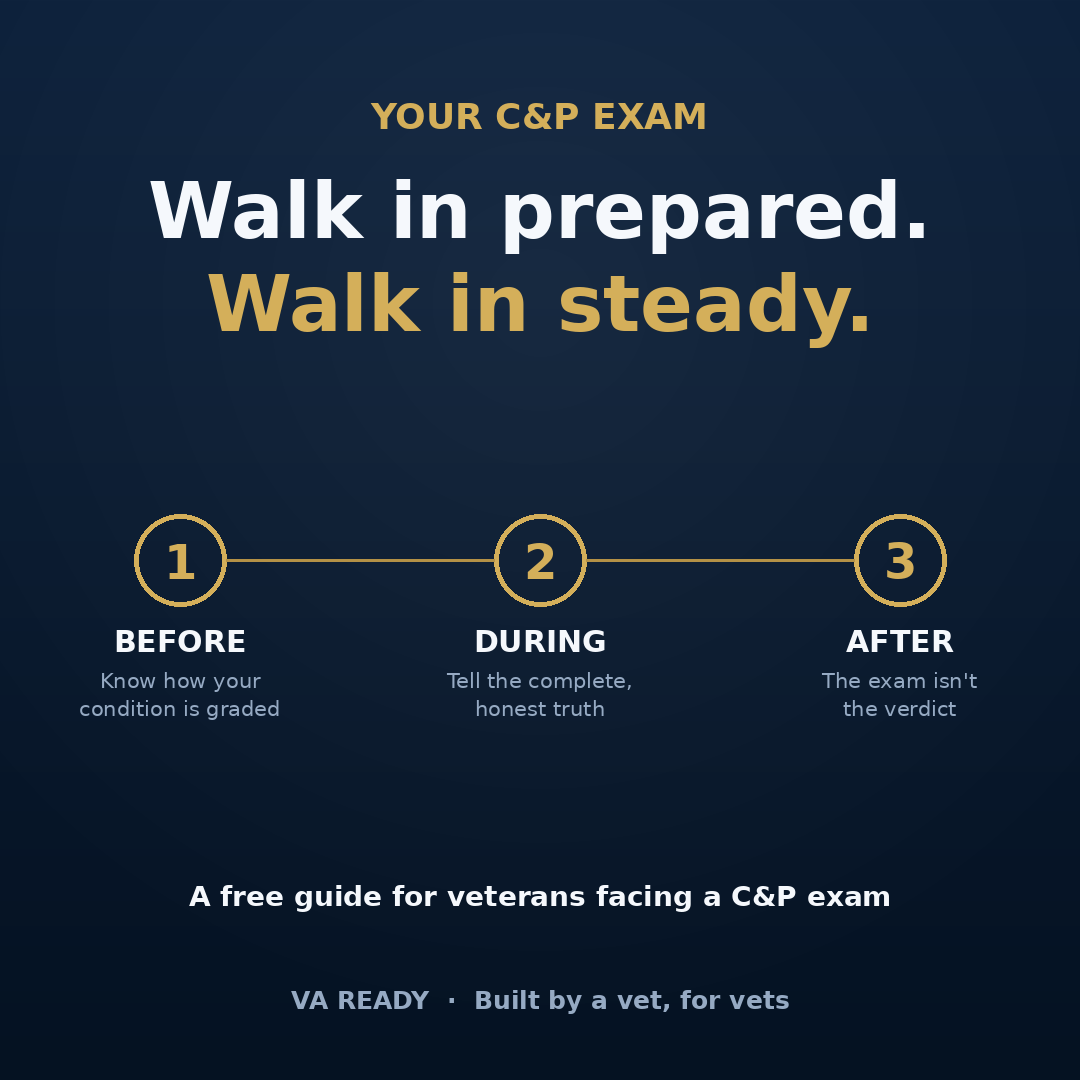
If you've got a C&P exam coming up, odds are you're nervous about it. That's normal. For a lot of us this one appointment feels like the whole claim rides on it, and the not-knowing is the worst part. So let's take the mystery out of it. Here's what a C&P exam actually is, how to get ready, what to do while you're in there, and what happens after, so you can walk in steady instead of stressed.
First, what a C&P exam actually is (and isn't)
C&P stands for Compensation and Pension. It's an exam the VA sends you to so a provider can document your condition. Here's the part that takes a lot of the pressure off: the examiner is not the person who decides your claim. They don't approve you or deny you. Their job is to fill out a form called a DBQ, a Disability Benefits Questionnaire, and document what they observe. A rater back at the regional office is the one who actually decides your claim, using that DBQ plus all the evidence in your file.
That matters because it means the exam is one piece of the puzzle, not the whole thing. A short exam isn't automatically a bad exam. A cold examiner isn't automatically a bad outcome. Their bedside manner has nothing to do with your rating. Keep that in your back pocket if you walk out feeling like it went fast or felt impersonal. It happens all the time and the claim still comes back fine.
Before the exam
A little preparation goes a long way, and most of it is just getting your own story straight in your head.
Know what you claimed and why. Go back through your claim and remind yourself which conditions you're being seen for. Examiners sometimes cover several in one visit. You don't want to forget to mention one because you got flustered.
Think through your worst days, not just today. This is the big one. A lot of vets walk in on a decent day and describe how they feel right then. But your condition isn't just today. It's the flare-ups, the bad weeks, the days you couldn't work or couldn't get out of bed or couldn't be around people. The VA rates you on the full picture, including your worst, so go in ready to describe the whole range honestly, not just the snapshot of how you feel sitting in that chair.
Know what the VA is actually measuring. Here's something most vets never find out until after they're denied: the VA rates every condition against specific criteria written into the regulations, the rating schedule in 38 CFR. There's an exact list of what separates a 30 percent rating from a 50 or a 70, and it's different for every condition. If you know what those criteria are going in, you know what the examiner is documenting, and you know which parts of your daily reality actually matter to your rating. This is exactly why we built the rating criteria and filing guides into VA Ready, pulled straight from the regs, condition by condition. You walk in knowing how your condition is graded instead of guessing. Whether you use our app or dig through 38 CFR yourself, do not go in blind to how you're being measured.
Write a few notes if it helps. There's nothing wrong with bringing a short list so you don't blank. When did this start. How often it happens. What you can't do anymore that you used to do. How it affects your work, your sleep, your relationships. Nerves make people forget things, and a few notes keep you grounded.
Bring your evidence if you have it. Any records, a symptom log, statements, anything that backs up your claim. If you've been keeping a daily symptom log, this is exactly what it's for. Hand it over or reference it.
Show up. This sounds obvious, but missing a C&P exam can sink a claim faster than almost anything. If you absolutely can't make it, reschedule through the proper channel. Don't just no-show.
During the exam
Be honest, be thorough, and don't tough it out.
Here's the trap a lot of us fall into, and it's the Marine and soldier in us. We were trained to minimize. Suck it up, walk it off, never admit weakness. That instinct will hurt you in a C&P exam. This is the one place you need to put it down. When the examiner asks how you're doing, the honest, complete answer is the right answer, not the tough-guy answer. Don't downplay your pain. Don't say you're fine when you're not. Don't gloss over the bad days because you don't want to look weak. Telling the examiner the real, full truth of how this affects you is not weakness. It's the whole point of being there.
At the same time, do not exaggerate or invent anything. You don't need to and it can blow up your credibility. The goal isn't to perform. The goal is to stop minimizing and tell the complete truth, including the parts we're trained to hide.
Answer the question they ask, but if something important isn't getting covered, it's okay to say so. "Can I add something about how this affects my sleep?" You're allowed to make sure the full picture gets on paper.
If a physical movement hurts, say so, and don't push through it silently. If they ask you to bend or reach and it causes pain, tell them, that's information they need to document.
Take your notes in with you if you brought them. Nobody's going to think less of you for being prepared.
After the exam
The waiting is the hard part, so here's what to actually expect.
You probably won't get an answer in the room. The examiner finishes the DBQ and sends it back. Then your claim goes to the rater, and the decision comes later. Don't read the outcome from how the exam felt. Fast and cold can come back favorable. Long and friendly can come back lower than you hoped. The feeling in the room is not the result.
You can request a copy of your C&P exam results. You're entitled to your own records, and some vets like to see what the examiner wrote. An accredited VSO can often help you get and read them.
If it comes back lower than it should, that is not the end of the road. A bad rating or a denial gets challenged all the time and won. You can file a Supplemental Claim with new evidence, or a Higher-Level Review. Plenty of claims that came back wrong got fixed on the next step. One exam is not the final word.
On the stress, because it's real
The anxiety waiting on a decision is one of the hardest parts of this whole process, and nobody talks about it enough. If you're losing sleep over it, you're not weak and you're not alone. A couple of things that help: get with an accredited VSO so you're not navigating it by yourself, lean on the people in your life, and remember that you already did the hard part by filing and showing up. The waiting is out of your hands now. Let it cook.
And if the stress of all this is pulling you somewhere dark, reach out to someone. The Veterans Crisis Line is there 24/7 — dial 988, then press 1. Your buddies are there, your people are there. You made it through worse than a claim decision. Don't carry the wait alone.
The bottom line
A C&P exam is one documented piece of your claim, not the verdict. Prepare by getting your story straight and thinking through your worst days, not just today. In the room, put down the instinct to minimize and tell the complete, honest truth. After, don't judge the result by how the exam felt, and know that a bad outcome can be challenged and won. Get an accredited VSO in your corner, and don't let the wait eat you alive.
And if you want to walk in knowing exactly how your condition gets graded, that's what we built VA Ready for. The rating criteria and filing guides come straight from the regs, condition by condition, so you understand how you're being measured before you ever sit in that chair. Free to start, and your information never leaves your device.
You've got this. Go in steady.
Built by vets, for vets.